|
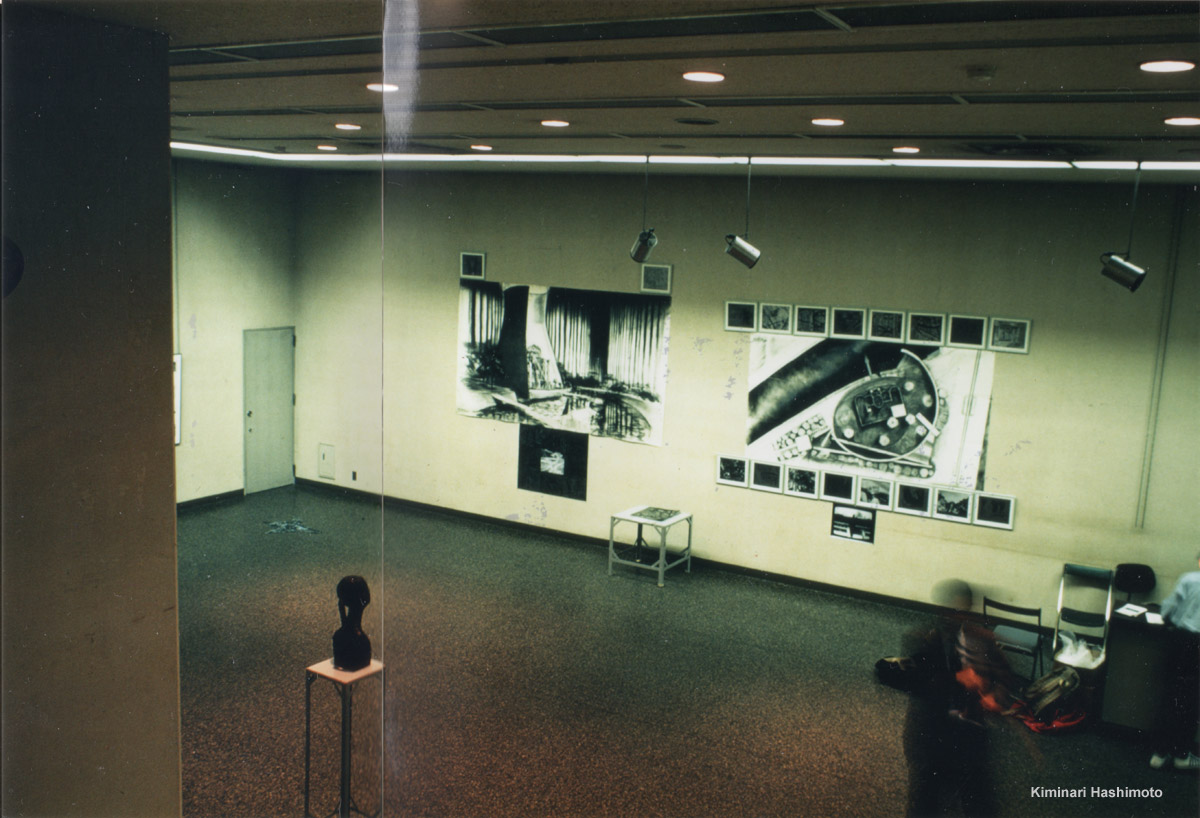
| "MOTHER 2 prototype" Kiminari Hashimoto 1999;AV機器,アクチュエーター,光源類,アナログ制御回路他 photo by Ito tetsuo 撮影:怡土鉄夫 |
①体験者が映像を動かす
体験者の発汗などによる、身体の電気抵抗値の変化をスイッチとして映像機器,光源,アクチュエーター類を作動させる。
date: June 1999
scale: 600(H)500(W)500(D)cm/installation area
materials: medical instrument, monitor, projector(video,slide), control circuit,VTR,lights,headphone,mirror,etc.
exhibition: MEDIASELECT 1999

The person who tries to experience this work must sit on a chair and put on a headgear and are forced to listen to baby's squall and see squalling baby's mouth. The change in electro resistance level of bodies by secretion of sweat etc. activates visual devices, lights and actuator and influences the visual image (gigantic image of a pregnant woman who is rubbing her abdomen slowly) projected on the wall. The image projected on the wall all the time seems to appear like a spiritual medium in the real space, as the image is taken with black background. It has a significant meaning for the work and for the exhibition space (a grain warehouse with the ceiling of six-meters high) to use the image as a spiritual medium that appears in the space, instead of using a screen and showing it as a framed flat image. It was impossible to show this gigantic woman's image with the height of six meters if it were not in this space. Therefore, this work can be called a site-specific media installation.
Two kinds of other images are overlapped on this image of a woman. One of them is 100-cut still pictures shown by a slide projector. The image of the back of a man and texts, empty cuts (light only) are reflected on a mirror with an actuator installed and they move vertically with high rapidity. The other image is a visual image of a fetus filmed with a supersonic camera and it moves horizontally at the level of the woman's abdomen. Both images are made that audience do not become aware of camera's frame, and they seem to be synthesized with the woman's image. However, unlike digitally edited images, these images can move around in 3-D space by moving each device separately.
The change in detection of body electro resistance level, which is set with five levels, activates visual devices, lights and the actuator for projecting them to the space. When the electro resistance level of the experiencers reaches the highest level, all the devices are activated and lights white out the image on the wall. This situation is rather violent.
This work replaces experiencers' physiological reaction with visual phenomena and creates spectacular visual spaces out of them. It can be seen as a visual-image mixer which takes the experiencer as a media. The audience sees the experiencer (=media) and the change in the image on the wall, which exteriorizes the experiencers' physiological reaction. Lobotomy device which stimulates maternity by perforce and the visual space which is programmed to change in advance (closed-circuit-installation).
This is a meta-media installation which metaphorizes the brainwash of women by the paternal society (culture), and presents a model of the information society.
 |
| M2-system Kiminari Hashimoto 1999 |
Background of the work -------------------
"Why do baby's squall make us feel fear or even hideousness?" -Consideration about maternity in the environment where corporeality is weak.-
The title of this work "MOTHER 2 prototype" implies not only an experimental of the work with the same title presented since 1997, but also a prototype of the secondary "mother" and the secondary "motherhood" "Does a mother react to the digitalized baby's squall and mother's milk would be induced?" With this rather non-sense question and the production of a device that draw the experiencers' physiological reaction (milking suit), this series of works has started. The below is the original interest points. A question about "motherhood" which we are told to be invested in women as instinct from the beginning.
Empathy and physiological reaction to life and body that are made into digital information. It is not communication between real human beings, but that through media.
The possibility of biological human being which is changing in the digital information society. The information provided by perforce to experiencers (image of baby's mouth and squall) is the same in the first work and this work. The image and sound is cut out from daily life for several minutes and framed and edited into endless VTR. By putting them in different space, it gains different meaning.
Why do baby's squall make us feel fear or even hideousness?
Our history has been modernized by deleting hideous nature as its dark side. It is often said that to us, who stand on such a history, the only nature left is body, and events of birth and death. But today, even that recognition is becoming weak. Life appears in such a civilized human society all the sudden as hideous nature. Sometimes our confusion about how to communicate with life comes up to the surface as incidents like abandonment of mothering and child abuse.
Provided that "motherhood" is invested originally and biologically from the beginning, the secondary motherhood can be considered to be inprinted artificially and a posteriori by information. It is possible to say that it is the history of paternal society (= culture) that prewires women that female is the gender which born and raise children. The presentation of this work metaphorizes such messages.

②映像を巻き取る
 |
| "CLOTHO" Kiminari Hashimoto 1995;スライドプロジェクター,100カットの35mm ポジフィルム,綿ロープ,木,鉄,下駄 |


③映像の中に入って見る |
| "Face to face" Kiminari Hashimoto 2007;ビデオプロジェクター,VTR,布 写真撮影:青木孝夫 |


 |
| 写真撮影:青木孝夫 |

【for image experience / 映像体験のために】
19世紀末(1895年)リュミエール兄弟が発明したシネマトグラフに始まるスクリーンに向かって大勢で一つの動画を見る映画館。
箱の中に入った一台のテレビを家族全員で見た昭和30年代。
VTRの登場で独りで見る映像体験が主流に変化し、やがて、深夜のファミレスでは、恋人たちは向かい合って座りながら、お互いスマホをいじって異なる映像を見る。
そんな20世紀末~21世紀初頭の仕事。
 |
| installation view at Nagoyako(Nagoya port) subway station: Kiminari Hashimoto 1999 |
art-05
https://www.facebook.com/kiminari.hashimoto/posts/798837823528825